Episode · Paleolithic – later prehistory · First traces
Before names, there were marks
Between 30,000 and 11,000 years ago, Paleolithic hunters engraved horses, signs and human figures in Los Casares and La Hoz, the highest caves with Paleolithic art in Europe. Neanderthals had already lived in Los Casares. Much later, between 8,000 and 4,000 years ago, others painted hunting scenes in the rock shelters of Rillo de Gallo, now a World Heritage Site.
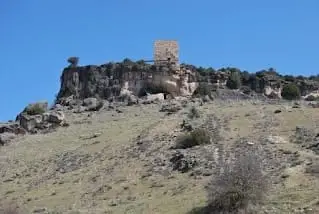
Photo: El Observario
A cave for two human species
Los Casares cave opens about three kilometres from Riba de Saelices. It extends for nearly 265 metres: a large entrance chamber of around thirty metres, reached by daylight, a first chamber of about twenty, and then a tall, narrow passage.
Its first known inhabitants were not like us. Neanderthals occupied it in the Middle Paleolithic. Excavations have uncovered their stone tools, bones of the animals they ate, and a bone from one individual’s hand. Thousands of years later, modern humans entered, and it was they who engraved and painted the walls. Javier Alcolea and Manuel Alcaraz, the University of Alcalá researchers excavating the cave, therefore call it “a cave for two human species”: two species that used it at different times, without meeting there.
Horses, signs and people
Juan Cabré brought the art of Los Casares to public attention in the 1930s. It belongs to the Upper Paleolithic, roughly 30,000 to 11,000 years ago, and shares techniques and styles with art elsewhere in the Peninsula and southern France. It has two distinctive features, however: abstract signs characteristic of the Peninsula’s interior and, above all, a group of human figures uncommon in art of that period. Since 2014, new excavations and a meticulous examination of the walls have revealed more animals, signs and human figures that had previously gone unnoticed.
The Geopark guide highlights another unusual feature. Los Casares and La Hoz cave, in Santa María del Espino, stand at over a thousand metres above sea level, making them the highest sites with Paleolithic art in Europe. The people who engraved there knew how to live in a climate that could be very harsh. La Hoz cave, discovered by Cabré in 1933, contains around two hundred engravings and is closed to protect them.
Los Casares did not remain empty afterwards. Inside are Chalcolithic remains from between four and three thousand years ago, and in the 10th century a settlement of al-Andalus with a tower was built on the hillside.
Hunting scenes in the open air
The art that came later is found in rock shelters open to daylight. It is more recent, dating from roughly 8,000 to 4,000 years ago, and has two styles. Levantine art depicts people and animals naturalistically, sometimes in hunting scenes. Schematic art reduces human figures, suns, snakes and signs to a few strokes.
Both appear in the rock shelters of Rillo de Gallo, near Molina: Rillo I, also called El Llano, and Rillo II. At El Llano there are eleven figures, including Levantine humans and animals and a schematic cross-shaped figure. These are among the westernmost examples of Levantine art. Since 1998, they have formed part of the World Heritage Site covering the rock art of the Mediterranean Basin.
At Peña Escrita, in Canales de Molina, an inclined slab about thirty metres long above a stream is covered with large engraved human-shaped figures. Locally they are said to be “of the Moors”, but their date is uncertain.
How to see them
Los Casares requires a guided visit and advance booking; visit times are listed on its page. La Hoz cave is closed. The shelters at Rillo and Peña Escrita are outdoors: do not touch them, wet them to see them better, or mark them. What came next, the fortified settlements of the Iron Age, is told in the Celtiberians. The time before any humans is in Before us.
Vocabulary
- Upper Paleolithic
- The final stage of the Paleolithic, associated with modern humans; in this region, roughly 30,000 to 11,000 years ago.
- Neanderthal
- An earlier human species that lived in Europe during the Middle Paleolithic and occupied Los Casares cave.
- Rock shelter
- A shallow recess beneath a rock overhang, open to daylight.
- Levantine art
- Naturalistic paintings of people and animals, often in hunting scenes, characteristic of the Mediterranean side of the Iberian Peninsula.
- Schematic art
- Later paintings that reduce human figures, suns, snakes and signs to simple forms.
- Anthropomorph
- A figure with a human form.
Where to see it today
Cueva de los Casares: Paleolithic art, Neanderthals, and Islamic tower
Riba de Saelices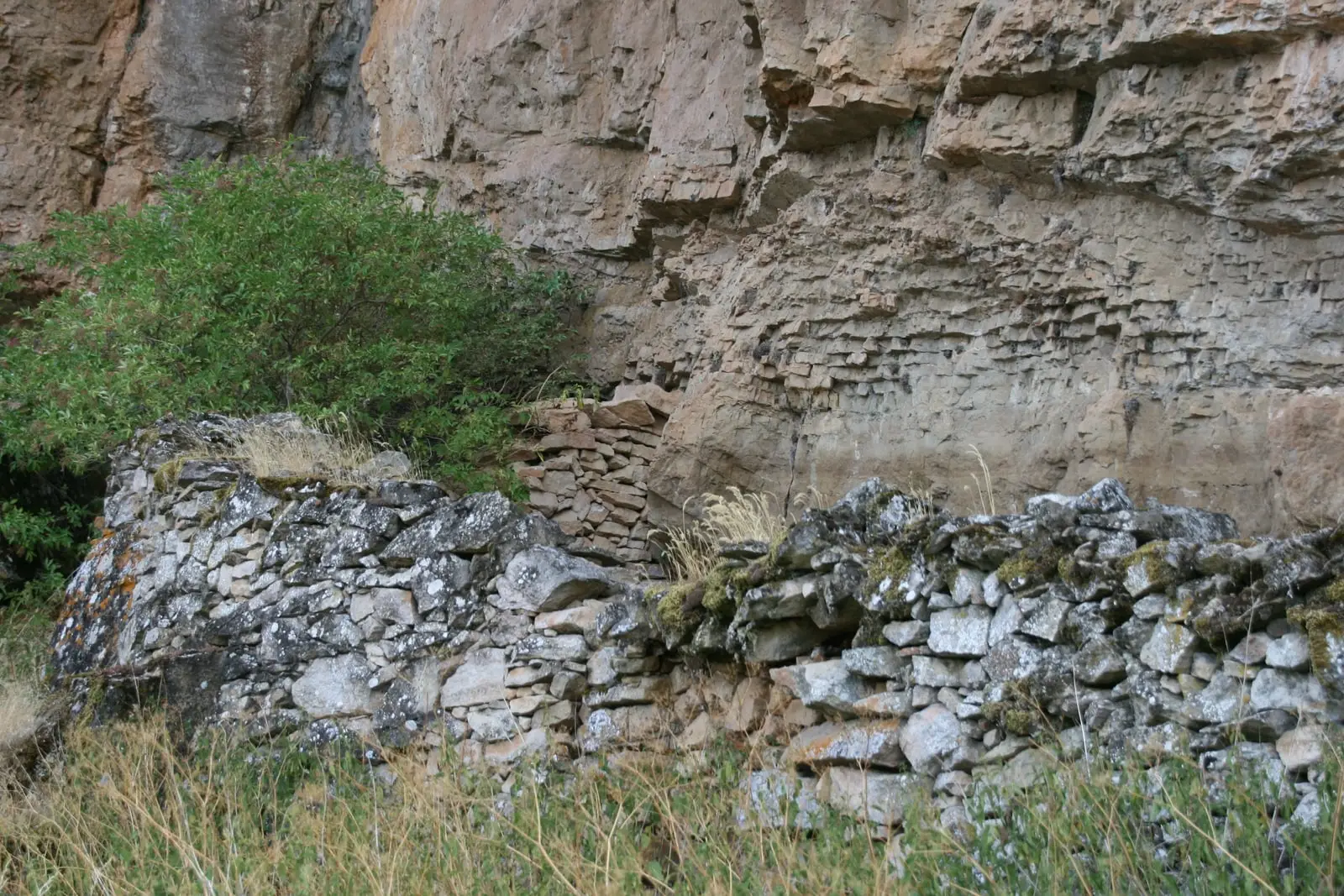
Cueva de la Hoz (Santa María del Espino): Paleolithic art of the Tajuña
Santa María del Espino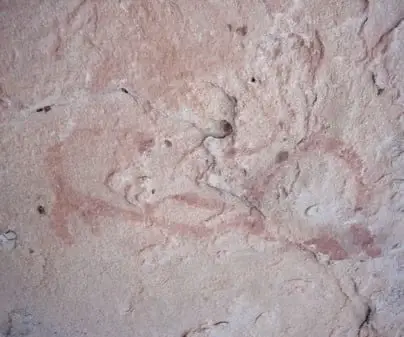
Rock shelters of Rillo de Gallo: UNESCO World Heritage Levantine art
Rillo de Gallo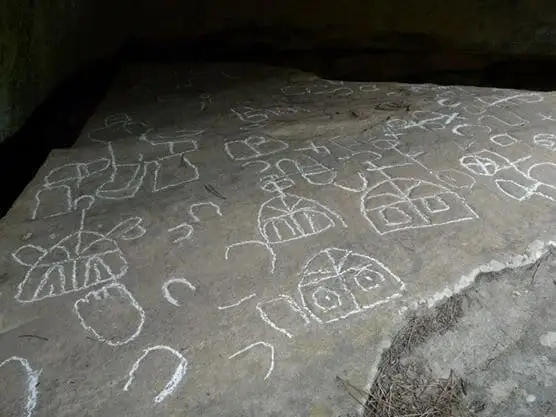
Peña Escrita (Canales de Molina): rock engravings with human figures
Canales de MolinaFrequently asked questions
Can you see Paleolithic engravings in Alto Tajo?
Yes, at Los Casares cave in Riba de Saelices, on a guided visit booked in advance. La Hoz cave in Santa María del Espino is closed to protect its engravings.
What makes the art of Los Casares special?
It lies in the interior of the Peninsula, an area once thought peripheral to Paleolithic art, at over a thousand metres above sea level. It also contains a very unusual group of human figures alongside animals and signs.
Sources and readings
- Guía turística del Geoparque Molina-Alto Tajo (2015), arte rupestre prehistórico, pp. 42–43.
- Universidad de Alcalá, investigaciones de Alcolea y Alcaraz en la Cueva de los Casares (27 de julio de 2020).
- Museo Arqueológico Nacional: «Una cueva para dos humanidades», conferencia de Manuel Alcaraz y Javier Alcolea (2019).
Further reading on the history of this land. Full bibliography.
Next story: Resin tappers: pine woods that smelled of work