Episode · 1904 – the postwar years · The frontline on the river
The war that entered people’s homes
Isidro García was nine and tending sheep in Checa when war began. In Alustante, shopkeeper Crescenciano Lorente, a former Republican mayor, had to leave. La Previsora, the association Checa’s farmers founded in 1904, never recovered. Three stories from local magazines tell the war from inside people’s homes.
A nine-year-old shepherd
Isidro García Gómez was born in Checa on 6 March 1927, at home as children were then, with the village doctor and someone to help. He was the fifth of eight siblings. At nine he was already tending sheep, and that was how war reached him, out in the countryside. He could not attend school. He learned reading, writing and the four arithmetic operations from Luis Martínez, tío Leyes, another shepherd, whom Labordeta would interview years later in Un país en la mochila.
His granddaughter María Lozano wrote his life in Aguaspeña in 2011. The family lived seasonally in Sierra Molina, Checa’s farming area. During the war they did not suffer too much hunger: his mother baked bread with their own wheat and they had animals. Even so, it was a hard time. As a child he played gua and cartetas, always in the street.
Then came life as a transhumant shepherd. Each winter he took the flock down to Andalusia or Ciudad Real, with mastiffs, herding dogs and Percheron mares pulling the cart. Reaching the estate on foot took almost a month. There he lived in a farmhouse without electricity or running water, drinking from the well and washing in the stream. Later he walked only as far as Chillarón in Cuenca, where the livestock continued by train. In his final years the whole journey to Jaén was by lorry. He said trains and lorries were harder on the animals than walking. Transhumance lasted almost his whole life.
Sierra Molina, no man’s land
The mountains where Isidro’s family lived lay between the two fronts during the war. Antonio Martínez Mansilla tells it in his history of La Previsora: Sierra Molina’s fields could not be cultivated because women, children, ploughmen, shepherds and livestock risked capture during raids by Republican troops stationed along the Teruel and Cuenca boundaries. This is a Checa resident’s account, written in 1994. He recalled the same thing in another article, the old farmers’ story: cultivation stopped in the mountains and had to be resumed afterwards.
What the farmers had built
La Previsora was founded by Checa’s farmers on 24 June 1904, Saint John’s Day. Before it, borrowed seed had to be repaid at usurious interest. The association began with a house and heaps of wheat, rye, oats and bitter vetch. It lent a fanega of grain and collected a fanega plus a celemín at harvest, enough to grow and cover losses. Any village household head could join, farmer or otherwise. The mayor was president; other officers were elected. Missing a meeting brought a one-peseta fine, and a fourth absence meant exclusion.
With its resources, La Previsora extended free medical care to all residents. Its building held the infant school and granary downstairs and the dance hall upstairs. In 1917 it owned the house on Calle Larga housing the Civil Guard barracks. Members challenged the boundary settlement that had deprived Checa’s residents of over 2,500 hectares of Sierra Molina, and in 1931 the Supreme Court ruled in their favour. At its peak the association held 3,541 hectares in its name.
The war effectively left it without land it could work. In 1944 members did not renew it, and it ceased to exist.
The shopkeeper who had to leave
In Alustante, Victoriano Pérez, over ninety, recalled the shops of his youth for Hontanar in 2008. There were many early in the century. One belonged to Crescenciano Lorente, “Usebiete”, a neighbour of his parents-in-law, whose shop he remembered as “very good”. Crescenciano had been a Republican mayor, and had to leave the village during the war for that reason.
Victoriano’s parents-in-law had their shop where his home later stood, selling everything. He and his wife María took over. In the late 1960s they moved to Puerto de Sagunto so their daughter could attend secondary school, then to Valencia, where they opened another shop. Victoriano continued farming his Alustante land. Eventually they returned to the village. At ninety-five he still went out gathering sage and mushrooms.
After the front
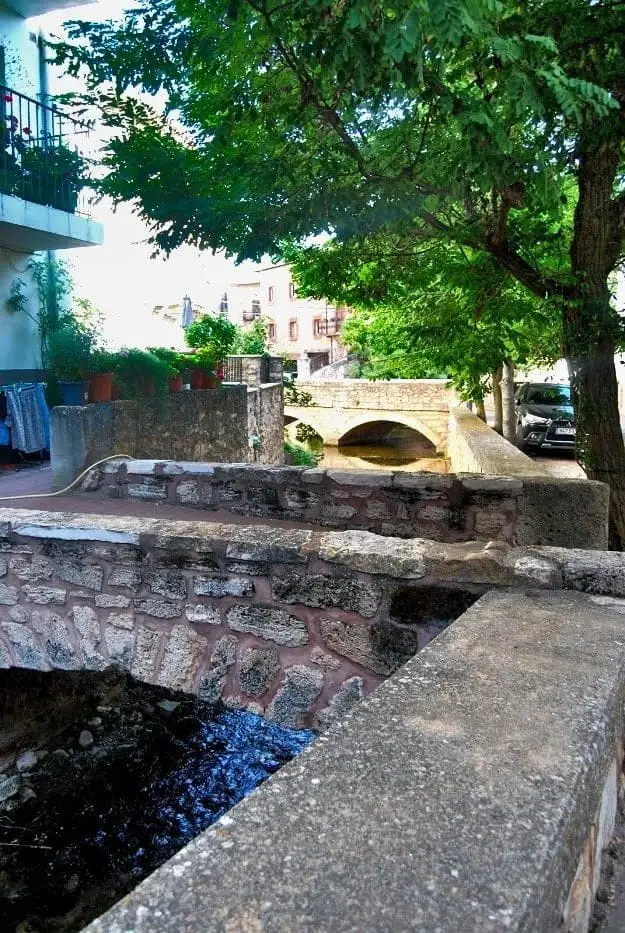
These lives continue where the trenches of the river front end. Paulino and Silveria’s story, also from Alustante, leads from the postwar years to emigration to Madrid in 1963, in The bread Paulino saved. In Checa, the old barracks occupied numbers 3 and 5 Calle Larga, La Previsora’s house. The new building was constructed from 1949 on land the council gave to the state.
Vocabulary
- Vereda
- The route followed on foot by transhumant livestock, and the journey itself: hacer la vereda.
- Fanega and celemín
- Grain measures. La Previsora lent a fanega of seed and collected a fanega plus a celemín at harvest.
- Quinta
- The cohort of young men called up for military service in the same year. Isidro belonged to the 1948 cohort.
- Línea and puesto
- In the Civil Guard, the puesto was a village’s basic unit; a línea grouped several units along a route.
Where to see it today
Sources and readings
- María Lozano, «Biografía de mi abuelo Isidro». Aguaspeña 18 (2011), pp. 12–13.
- «El puesto, la línea y el cuartel de Checa y Orea». Aguaspeña 18 (2011), pp. 14–15.
- Ángel Lorente Lorente, «Nonagenarios alustantinos IV: Victoriano Pérez». Hontanar 48 (diciembre de 2008), pp. 6–9.
- Antonio Martínez Mansilla, «La Previsora». Aguaspeña 1 (1994), pp. 4–7; colección de la revista.
Further reading on the history of this land. Full bibliography.
Next story: The bread Paulino saved