Episode · 1st – 4th centuries and later uses · Rome in the canyon
The water Rome brought across
In Zaorejas they call it the Roman Bridge, but it is an aqueduct: a 95-metre wall with a double-ring arch carrying water from La Barbarija to the village, built between the 2nd and 3rd centuries. Rome reached Alto Tajo late and selectively. Of the area’s 35 Roman sites, only one villa has been excavated: Las Casutillas in Corduente, with underfloor heating and a mosaic pool.
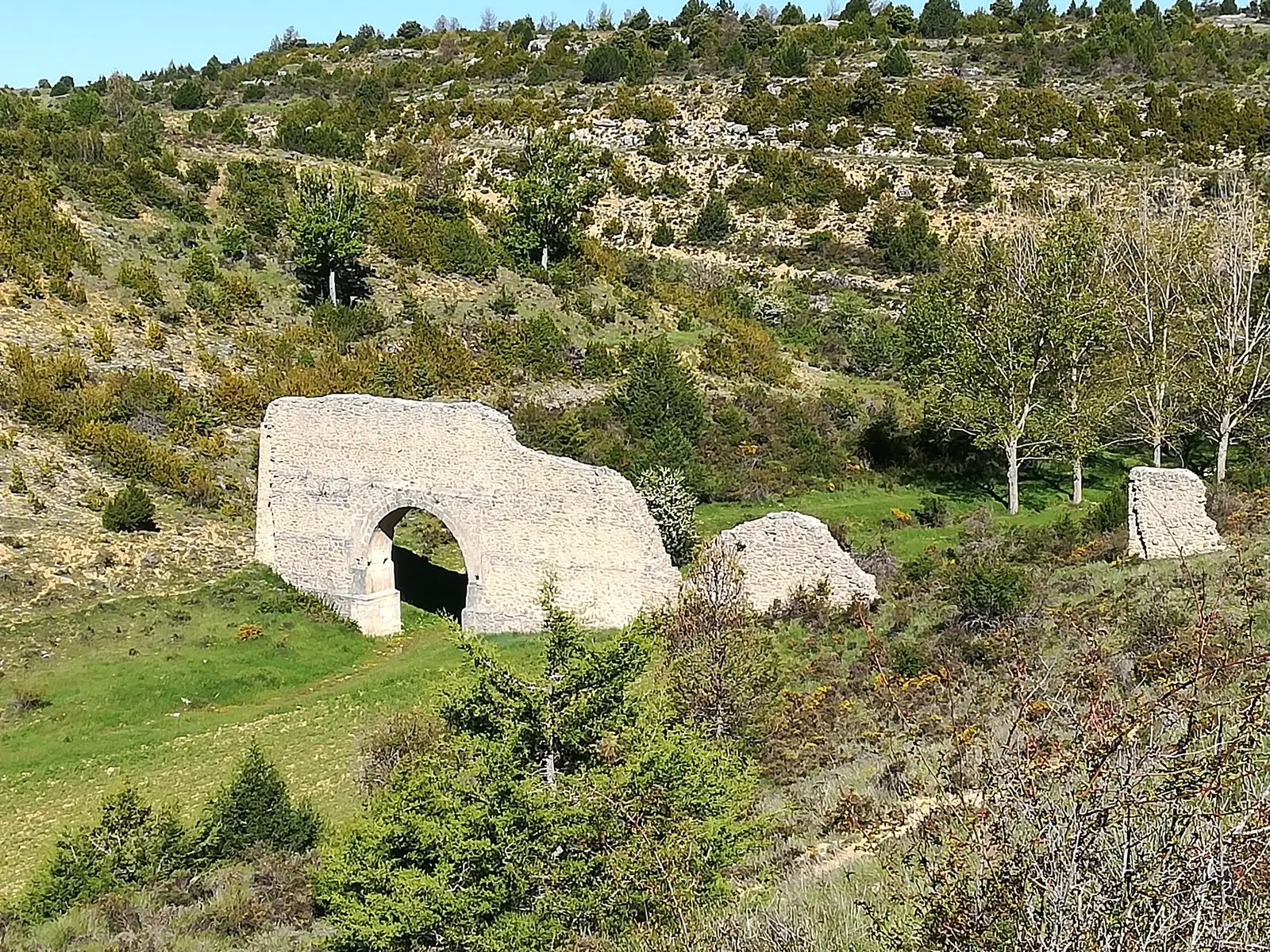
Photo: «Zaorejas Acueducto Romano», Juan José Estrada Martínez (2018) · CC BY-SA 4.0
A bridge that turns out to be an aqueduct
When Pedro José Pradillo began spending summers in Zaorejas, he wanted to study the village’s history, but the municipal and parish archives had disappeared during the war. He asked residents about any ancient monument, and they proudly replied that they had a Roman bridge. Vicente Lara took him to see it. He expected to descend towards the Tagus, but they returned to the village and walked to the Fuentelengua ravine. Less than a kilometre away, beyond the bend at Fuente de los Chomos, a great stone wall appeared with an arch in its centre, as though blocking the ravine.
It was an aqueduct. Zaorejas stands on the plateau’s edge at around 1,270 metres, separated by the Fuentelengua ravine from springs on the other side. Good water emerged at La Barbarija, around 1,260 metres, and needed carrying to the village fountain, over a kilometre away at 1,220. The aqueduct crossed the ravine above 1,250 metres, allowing water to flow by gravity even as far as the threshing floors.
What it looked like
Complete, it was a wall around 95 metres long and almost 12 high, including the channel on top. Its faces are courses of irregular stones, opus incertum, and its core Roman concrete, opus caementicium. A semicircular arch spanning 6.44 metres, twenty-three Roman feet, allowed the ravine’s water through without damming it. It is a double-ring arch: two rows of voussoirs, 35 inside and 27 outside, of well-dressed limestone laid without mortar. Pradillo identified Vitruvian proportions: the arch fits a perfect square defined by the mouldings and cornice. Above ran a channel around 84 centimetres high with the water conduit, the specus, now lost.
Its simple structure, with solid walls rather than arcades, led Pradillo to date it to the 2nd or 3rd century AD. In 1921 two scholars of Roman roads had already reported a water conduit three hundred varas long at Zaorejas, linking it to the Roman posting station of Carae, an association later considered fanciful.
From “Moorish arch” to quarry
By the early 19th century the aqueduct was unused. Miñano in 1828 and Madoz in 1850 described Zaorejas’s water supply: wooden pipes descended the slope, crossed the ravine on a small timber bridge and climbed again to the square’s fountain, an arrangement admired by travellers. They called the arch the work of the Moors. Water still came from La Barbarija, as in Roman times.
When Pradillo studied it in 1993, the aqueduct had lost over 60% of its masonry. Stones had been taken to enclose gardens on one slope and build terraces on the other. The central section with the arch, 23.80 by 12 metres, remained, along with two detached stretches of wall. On the same outing Vicente Lara showed him sarcophagus remains beside the road and the “antitanque”, a small cave used during the Civil War below La Cabezuela’s Celtiberian settlement.
A villa in Corduente
Rome reached Alto Tajo late and only in a few places. Reviewing Guadalajara’s Archaeological Inventory in 2007, Marta Chordá counted 35 Roman-period sites in the area: almost none excavated, small and scattered, usually at strategic points controlling a route or resource. Roman itineraries record no major road crossing it, and Chordá supposes there was no town organising the territory either. She describes selective occupation: Rome settled where it suited its interests and left the rest to those already living there.
The exception is Las Casutillas, in Corduente, at the entrance to interior Alto Tajo. It is the only villa excavated with published results, in 1985. The site covers around eight hectares. The excavated area revealed an open space, two rooms with a hypocaust, hot-air underfloor heating, others with rough paving and part of a mosaic pool, apparently from Augustus’s reign, like the pottery and the few coins.
Iron before and after
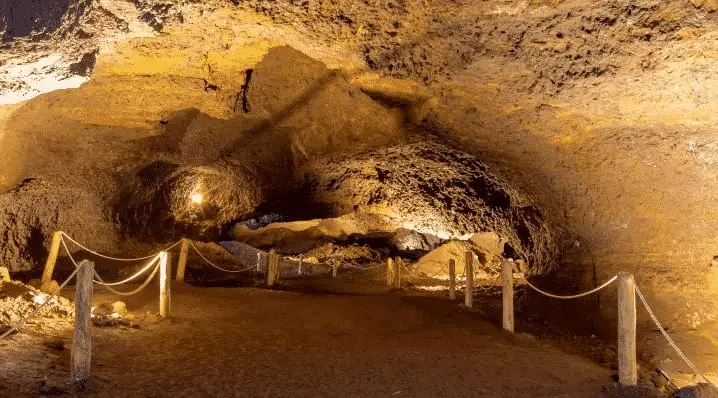
At Cueva del Hierro, in the Cuenca part of Alto Tajo, the mine was already worked around the 6th century BC, probably by Celtiberians whose iron made tools and weapons. Rome continued extracting ore, and Roman mining techniques can be recognised in the underground galleries. Further periods of work followed, until the mine closed in the 1960s.
What preceded Rome is in Alto Tajo’s Celtiberians; what followed, in the Lordship of Molina.
Vocabulary
- Aqueduct
- A structure carrying water across a change in level or a ravine.
- Specus
- The channel carrying water along the top of a Roman aqueduct.
- Double-ring arch
- An arch formed from two concentric rows of wedge-shaped stones, distributing weight more effectively.
- Voussoir
- Each wedge-shaped stone forming an arch.
- Opus incertum
- Facing built with irregular stones; at Zaorejas, the wall’s outer faces.
- Opus caementicium
- Roman concrete made with mortar and stone; at Zaorejas, the wall’s core.
- Hypocaust
- Roman heating using hot air beneath the floor.
- Villa
- A Roman country house and agricultural estate.
Where to see it today

Frequently asked questions
Is Zaorejas’s Roman Bridge a bridge?
It is an aqueduct crossing the Fuentelengua ravine to bring water from La Barbarija to the village. Pedro José Pradillo, who studied it in 1993, dates it between the 2nd and 3rd centuries AD.
Are there Roman villas in Alto Tajo?
Guadalajara’s Archaeological Inventory records five in the area, but only one has been excavated with published results: Las Casutillas in Corduente, covering around eight hectares, with hypocaust-heated rooms and part of a mosaic pool from the time of Augustus.
Sources and readings
- Pedro José Pradillo y Esteban, «El Puente Romano de Zaorejas. Un acueducto imperial en proceso de ruina». Wad-Al-Hayara 20 (1993), pp. 65–84.
- Marta Chordá Pérez, «La romanización en la zona del Alto Tajo». Caesaraugusta 78 (2007), pp. 417–424.
- Turismo de Castilla-La Mancha: Cueva del Hierro y su mina romana.
Further reading on the history of this land. Full bibliography.
Next story: The salt of the earth: inland saltworks in Alto Tajo