Episode · 1940 – 1975 · Resin, hooks and pastoral shelters
A year in a mountain village
Until the 1970s, almost everything in Alto Tajo’s mountain villages was communal and followed the calendar. Pastures were fenced with thorns in May, woodland gathering opened for everyone together, bread baked in the village oven and animals tended in turns. Residents of Valsalobre, Orea and Peralejos remember it firsthand.
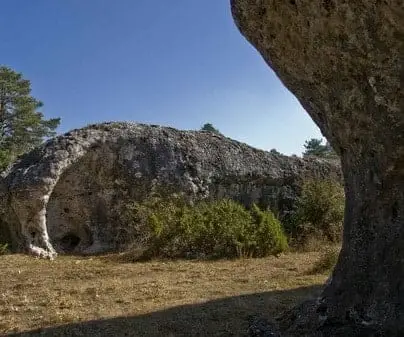
Photo: El Observario
A village working together
“There were no specialists in villages; we all did everything,” residents of Peralejos de las Truchas remember, summarising it with a man of many trades is sure to be poor. Until the 1970s, Alto Tajo mountain villages lived from farming, livestock and woodland, almost everything organised communally and in turns.
Valsalobre’s residents, in a Beteta village once more populous than Beteta itself, preserve that calendar. Across the mountains, Checa and Orea families recognise many of the same tasks.
The pasture fenced with thorns
The dehesa boyal was for working cattle and mules. Sheep were excluded; a guard finding them reported it. In May, as wheat grew, working animals needed keeping out of crops. Everyone cut thorns, dragged them with mules and closed every opening in the pasture.
This ended in closing day festivities: food, a little drink, a costumed resident performing a “Moorish entrance” on a mule in the square, and evening dancing. Next day came another communal task: clearing roads so harvest carts would not catch on brambles.
The dulero or mulero tended village working animals; the vaquero tended cows, sometimes a boy of nine or eleven sleeping in the pasture hut. A conch horn sounded in the morning — different ones for mules and cows — and households brought animals out. The job was auctioned and paid in wheat: several celemines per cow, half payment for someone with only one mule. Someone argued donkeys should pay less “because they were worse”.
If an animal escaped and ate another’s garden, common rules applied. Ciruelos del Pinar retains the Corral del Concejo, where offending mules or donkeys were enclosed until their owner appeared before the village’s hombre bueno, who assessed damage and payment. This was neighbours’ justice, without judges or papers. The Señorío’s sexmas did similar work at larger scale, sharing pasture, woodland and timber among villages. Sexma de la Sierra comprised thirteen villages. Enrique Arauz Estremera, Peralejos’s 19th-century doctor and mayor, wrote that representatives were elected beneath El Campillo’s oak within Alcoroches. A monument three kilometres from the village towards Traíd recalls it: Roble de la Sexma.
Woodland, restricted and shared
Woodland supplied almost everything, but gathering had appointed dates. Lavender, asphodel and acorns were vedados, prohibited until everyone could go out together. Some slept outdoors by the best patches the night before to be first at dawn.
- Lavender was cut in early September, weighed and distilled beside the village bridge. In households with little land, residents say it “kept us for half the year”.
- Asphodel and acorns fed pigs, cooked with pumpkin, potato peelings and bran.
- Mushrooms were used too. A resident recalls loading a mule with saffron milkcaps, locally mízcalos, and taking them to Cañamares to exchange for grapes, judged by eye, bulk for bulk.
- Oak firewood was pruned communally, stacked in numbered rimeros and allocated by lot. Large oaks served several households.
Resin paid best. Valsalobre had five tappers, one handling 3,500 pines. Raw resin went into clay pots made in Priego, paid by the vat. One resident earned his first good wages from it. See resin tappers.
Bread, water and washing
Bread baked in the communal village oven. Each household kneaded two weeks’ bread in a trough using starter saved from the previous baking. Loaves were carried on the head and marked with crosses or other signs. The baker won the oven auction for one or two years and was paid in bread.
Water came from the spring, pitchers carried on a cloth ring on the head. It was also where young men and women met; sometimes a pitcher was emptied simply to return. Clothes were washed in the river, breaking ice in winter. Laundry took three days: soaping, river washing, drying in sunshine on grass with repeated wetting, then rinsing.
Running water arrived late. Residents disagree: one places it in the early 1970s, another around 1984, recalling Valsalobre among the province’s last villages to receive it. Electricity entered homes one by one, paid per bulb according to wattage. A grandfather refused, fearing fire. When his son hung a 15-watt bulb and he saw it lit day and night, he eventually asked for one himself.
The pig, slaughter and eggs
“The pig saved our whole family.” Winter slaughter lasted two or three days, gathering relatives. Intestines were washed in the river. Chorizo and loin were stored in earthenware jars with oil for summer harvest meals. Hams were salted with one or two arrobas bought from the village saltworks.
Eggs were almost currency. Girls walked to Beteta with baskets, sold them and bought necessities. The best chicken was kept for a name day.
Harvest summer, absent winter
In summer everyone was reaping by hand, carrying crops by mule or circling during threshing, sometimes aged seven or eight in a little hat. Children who helped received ring-shaped buns afterwards.
In winter men were absent. Livestock owners went with animals to Andalusia or La Mancha; others became shepherds for someone else. Orea’s Paco Casado made that journey for over forty years, described in roads and livestock trails.
Festivals requiring permission
Festivals were few, small and not always free. A resident recalls the priest cancelling dances without “government permission”: “the secretary, priest and Civil Guard ruled here”. Even so, May songs were sung at young women’s doors, collections made during Holy Week and serenades held when someone returned from military service. A local musician played accordion; one came from Peñalén and was also sacristan.
At Easter came the Judas Pine. Young men chose the tallest tree, brought it on carts — sometimes two, front and back — and erected it with joined poles and forked supports. Judas hung above, and guards stayed all night because neighbouring youths came to topple it. Timber was later auctioned to fund the celebration. The last attempt to erect it “as before”, in the mid-1960s, failed: too few young men remained.
Departure
“In 1972, 1973 most people left.” Accounts agree. Orea once had three hundred household heads, one resident says. Young people went to Madrid, Barcelona or Valencia, Vadillos’s carborundum factory, or Cuenca on study grants. “There was only farm work; you marry, have children and leave for their sake,” a woman summarises. Slopes once ploughed with mules are now pine woods and scrub.
Those remaining repeat: without livestock or sowing, vegetation closes in and burns. “Hundreds of thorn bushes were cut to fence the pasture, and next year there were more,” a former shepherd says. It is an opinion, but held by people who spent four months annually sleeping outside with flocks.
What is moving again
In Orea and Peralejos, residents, a women’s association and councils seek woodland livelihoods through Del bosque a tu casa, “From the forest to your home”: thyme, lavender, mistletoe, rosehips, lime blossom and deer antlers for infusions, hydrolates and cosmetics. Peralejos recalls lime blossom and honey making chapurriado on wedding eves. “Full of resources and empty of opportunities,” Orea residents say — perhaps the finest definition of these mountains.
The calendar of newcomers
Elena Ivanciu arrived from Romania with her family. Her path included domestic service, a shop and hospitality. She recalled lockdown difficulties and help finding housing in Alustante.
The mountain year’s memory includes later arrivals too. Families add work, learning and new memories. Their experiences expand women’s voices and explain staying to live here.
An April morning in Traíd
Núria Sanz and Jesús Sanz recalled tree planting beside El Navajo in April 2004: seeking volunteers, Gildo’s tools and journeys carrying water. In June they reported the trees had taken root.
That morning left trees, names and shared efforts around a village space. This too made its landscape.
Vocabulary
- Sexma
- Each district of Tierra de Molina governing its common property.
- Hombre bueno
- A respected resident arbitrating minor village disputes.
- Dehesa boyal
- Common woodland reserved for working cattle and mules.
- Vedar
- Prohibiting woodland gathering until a fixed day shared by everyone.
- Dulero
- A resident tending the whole village’s mules and working animals, in turns or by auction.
- Gamón
- A white-flowered plant whose stems and roots were cooked for pigs.
- Rimero
- A firewood pile, numbered and allocated among residents by lot.
- Hornero
- The operator heating and tending the communal oven, paid in bread.
- Celemín and fanega
- Grain measures used to pay cowherds, millers or mule keepers.
- Mayos
- Verses young men sang to young women at their doors on May night.
- Judas Pine
- A very tall pine cut and erected in the square at Easter, with a Judas effigy hung above.
Where to see it today
Frequently asked questions
What was “closing day”?
In Valsalobre, when May arrived, the whole village cut thorns and fenced the common pasture to keep cattle and mules out of crops. It ended with food, drink, a costumed neighbour entering the square “as a Moor” on his mule, and dancing.
What is the Judas Pine?
An Easter custom: young men chose the tallest forest pine, brought it on carts and erected it in the square with a Judas effigy on top. They guarded it all night against neighbouring youths trying to topple it. Its timber was later auctioned to pay for the celebration.
How was woodland firewood shared?
Oaks were pruned communally. Wood was stacked in numbered rimeros and allocated to residents by lot. A very large oak was shared between two, three or four households.
Sources and readings
- Testimonios de vecinos de Valsalobre (Beteta) grabados por Vestal Etnografía: la dehesa, la resina y la leña; el espliego y el gamón; el agua y el horno comunal; los mayos y la matanza; las salinas y el Pino de Judas; la escuela; la taberna y el baile (YouTube, @vestaletnografia).
- Testimonio de Francisco Javier Casado Pérez, ganadero trashumante de Orea (Vestal Etnografía).
- Vecinos de Orea y Peralejos de las Truchas en el proyecto «Del bosque a tu casa» (Vestal Etnografía).
- Revista Aguaspeña (Checa), n.º 20: los viejos labradores.
- «El Roble de la Sexma, Alcoroches», Sierra Alto Tajo (sierraaltotajo.es).
- Núria Sanz y Jesús Sanz, «Día del árbol». El Torrejón 2 (julio de 2004), pp. 9–11.
- Elena Borbolla, «Alustante, pueblo de acogida». Hontanar 89 (julio de 2026), pp. 28–29.
Further reading on the history of this land. Full bibliography.
Next story: What people said while they worked